
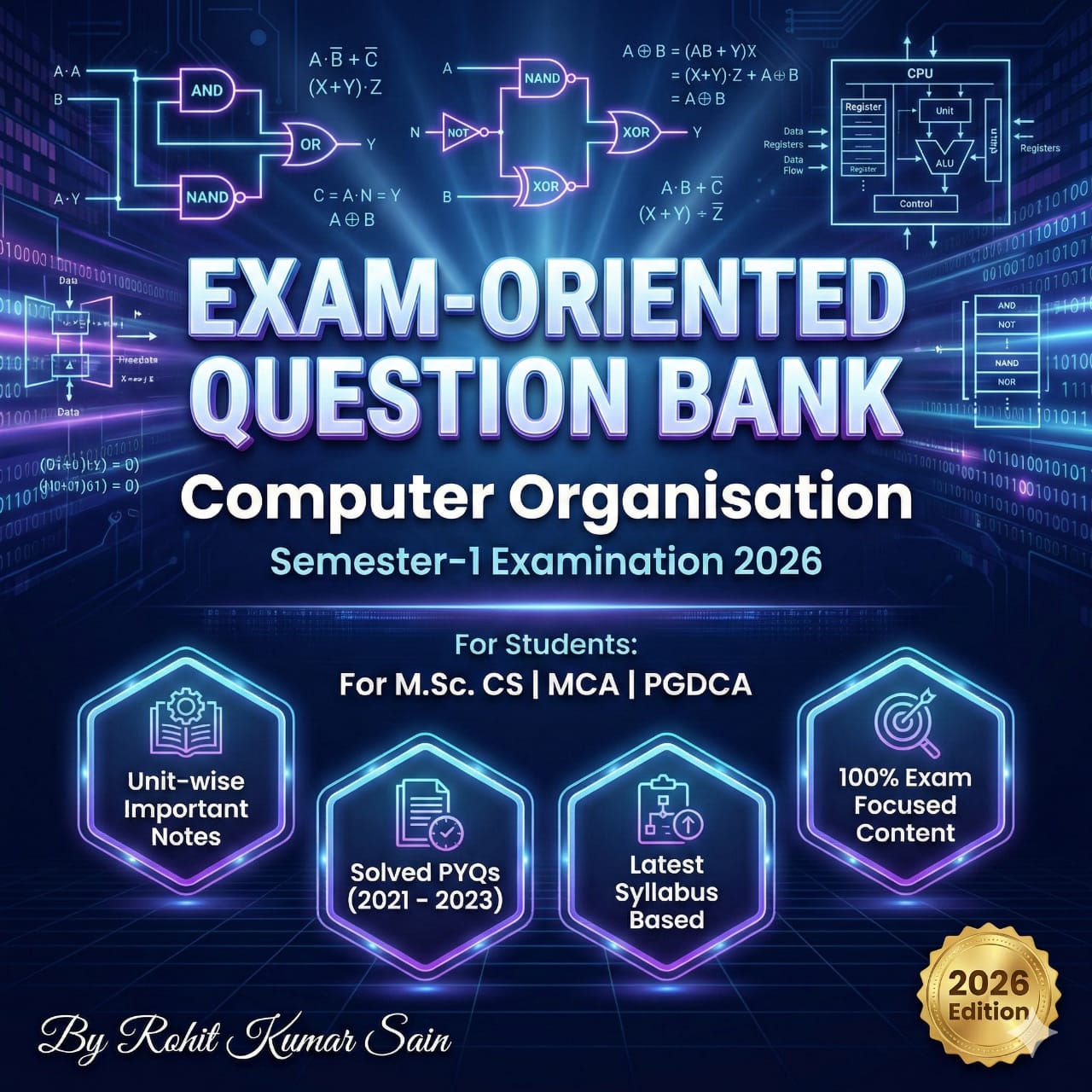
Exam-Oriented Question Bank: Computer Organization
By Rohit Kumar Sain
Simplify the complexities of hardware architecture and excel in your university exams with this targeted study guide. Specifically designed for MSc CS and PGDCA students, this booklet serves as a comprehensive resource for mastering the “Computer Organization” curriculum.
Overview
This book is a strategic revision tool that bridges the gap between theoretical concepts and examination requirements. It provides a curated collection of important questions and Previous Year Questions (PYQs) based on past academic trends, ensuring students focus on high-probability topics.
Key Features
-
Complete Syllabus Coverage: Detailed modules covering everything from basic number systems to advanced 8085 microprocessor programming.
-
Examination-Ready Format: Includes MCQs, Fill-in-the-blanks, and descriptive questions tailored to modern university patterns.
-
Step-by-Step Problem Solving: Clear, worked-out examples for complex topics like Booth’s Algorithm, K-map simplification, and binary conversions.
-
Visual Learning Aids: Contains diagrams for logic gates, flip-flop operations, and microprocessor architecture to enhance conceptual clarity.
-
Microprocessor Deep-Dive: Comprehensive notes on the Intel 8085, including its pin configuration, instruction set, and register structure.
Unit-Wise Content
-
Unit I: Basics & Number Systems: Components of a computer (Processor, Memory, I/O), bit/byte concepts, and 1’s/2’s complements.
-
Unit II: Logic & Arithmetic: Binary arithmetic (addition, subtraction, division), Booth’s Algorithm for multiplication, and Boolean Algebra with K-map simplification.
-
Unit III: Digital Circuits: Combinational circuits (Adders, Decoders, Multiplexers) and Sequential circuits (SR, JK, D, T Flip-flops, Counters, and Registers).
-
Unit IV: I/O & Memory Organization: Asynchronous data transfer, DMA, Priority Interrupts, and Memory Hierarchy (Cache, Virtual, and Associative Memory).
-
Unit V: Intel 8085 Microprocessor: Architecture, ALU, Timing and Control Unit, Addressing modes, and complete Instruction Set programming.
Why This Book?
Unlike standard textbooks, this Question Bank focuses on exam performance. It identifies crucial theoretical topics and provides concise answers designed to help students score maximum marks within university word limits.

Reviews
There are no reviews yet.